


Since 1972!
Global leader in Building Community-Based Farm and Food Systems
Building Community Food Webs through:
Food System Assessments for Locales, Regions, and States
Regional Farm and Food Plans
Strategic Advising for Commmunity Food Webs
Identifying Systems Levers
Feasibility Studies and Business Clusters
Most all of our reports are posted below. Each local study addresses national concerns.
ORDER HERE! Building Community Food Webs
Ken Meter’s book, published by Island Press, is now available: Building Community Food Webs. This book is the single best place to find both inspiration and pragmatic suggestions for your community foods work. It offers in-depth stories covering some of the most creative and resilient community foods initiatives across the U.S., and also features a groundbreaking and concise economic analysis of the extractive rural economy that has made this community foods movement so necessary.
Contact Ken for customized technical assistance, built upon your region’s unique assets.
Recent Impacts
The Land Connection (Urbana, Illinois – 2024)
The pandemic prompted many people to reach out to local farms for fresh foods. Yet many farms are now struggling as consumer interest wanes. What are the essential support networks required to keep farms and food systems resilient during the next crises? The Land Connection asked Ken to harvest insights from farmers across Illinois. Read at the link below.
Next Steps for Supporting Emerging Farmers in Illinois (2024).
Alaska Food Policy Council (2023-2024)
In collaboration with AFPC and 6 “food hubs” in Homer, Kodiak, Juneau, and Anchorage, Ken recommended several steps for strengthening the network. Alaska health officials at the State Department of Environmental Conservation, also collaborated. Read at link below.
How the Alaska "Food Hub" Network Can Best Move Forward (2024)
USDA Heartland Regional Food Business Center (2023-2027)
CRC consults with the USDA Heartland Regional Food Business Center in Kansas City and with No More Empty Pots in Omaha and the Center for Rural Affaris to strengthen local food business development.
Nebraska Farm and Food Economy (2024)
Statewide Food System Assessments
Ken Meter, often with former Associate Megan Phillips Goldenberg, has performed statewide (or provincial) food system assessments in fifteen states and provinces: Alaska, Arkansas, California, Hawaiʻi, Indiana, Manitoba, Minnesota, Mississippi, Nebraska, New Hampshire, New Mexico, Ohio, South Carolina, Virginia, & West Virginia. Eight of these are in-depth, and linked below. The others can be accessed by clicking on the box at the right.
 Nebraska Farm and Food Economy (2024)
New Hampshire Farm, Fish, & Food Economy (2019)
Hawaiʻi’s Food System: Food for All (2017)
Alaska: Building Food Security in Alaska (2014)
An Overview of Mississippi’s Farm & Food Economy (2014)
South Carolina: Making Small Farms Big Business (2013)
Hoosier Farmer? Emergent Food Systems in Indiana (2012)
Ohio’s Food Systems: Farms at the Heart of it All (2011)
Mapping the Minnesota Food Industry (2009)
20 Regional Food Plans and More than 100 Farm and Food System Assessments
See box at top right of this page for links to all of our local, regional, and state studies.
Recent Work:
Agricultural and Land-Based Training Association (ALBA) (2022-2023)
Ken assisted ALBA as it evaluated 20 years of success in land-based training to set up former farmworkers to manage their own farms.
Land Stewardship Project (LSP) (2023-2024)
Ken assisted LSP in exploring the feasibility of several potential community foods efforts including artisanal grain milling and feed grain milling
City of Salt Lake (2019-2023)
The City of Salt Lake asked us to explore the potential for a developing a food hub to be located in the Salt Lake City region. Report is posted below.
USDA/AMS Toolkit: How to Measure Economic Impacts of Local Foods Work
USDA Economic Impacts Toolkit. Ken Meter and Megan Phillips Goldenberg of Crossroads Resource Center are among 14 co-authors. The Economics of Local Food Systems: A Toolkit to Guide Community Discussions, Assessments and Choices
How do we uphold the integrity of local food?
As more consumers demand local food, some vendors have expanded their concept of “local” in questionable ways. How do we know what is the Real Deal?
Our research for the Pennsylvania Association for Sustainable Agriculture (PASA) found that the foremost quality of local food is that it creates community connections. To learn more, see: The Real Deal: How Do We Define “Local” in a Meaningful and Measurable Way?
Economic Impact Reports!
Critical Analysis of Economic Impact Methodologies
Economic impact analyses often are not as useful as they might be because the data used in calculating impacts is not as precise as users think it is. Furthermore, impact analysis software such as IMPLAN is often used inappropriately, since it is not fully sensitive to the business sectors that drive local foods work. Ken Meter and CRC Associate Megan Phillips Goldenberg have produced a critical analysis of these methodologies, and suggest new directions for measuring economic impacts. This is part of a larger report published by the Illinois Public Health Institute with funding from the Centers for Disease Control and Prevention.
Exploring Economic and Health Impacts of Local Food Procurement
Interviews with local food leaders in five selected regions across the U.S. showed how farm-to-school and other institutional food purchasing can help create, and help lead to, positive economic and health impacts. Drawing upon case examples from Vermont, Louisville, Southwest Wisconsin, Tucson, and San Diego, this new report highlights the ways in which economic and health impacts may be measured. Meter and Goldenberg were part of the team that produced this study, published by the Illinois Public Health Institute with funding from the Centers for Disease Control and Prevention.
Food Hub Resources from the Midwest:
What is needed for a food hub to thrive?
Shane Tiernan, a banker in Grundy, Iowa, spells out what details need to be pinned down if a food aggregation facility is to cover its operating costs. His report, Can a Diversified Locally Grown Food Aggregation (Hub) Facility be Economically Sustainable in Iowa?, raises most all of the difficult issues that emerge when one plans a food hub. This is an important report to read!
The long road to a cluster of food businesses:
The Twin Cities cooperative grocery sector is now $180 million strong—and it took 40 years to get there. Read this report— The Twin Cities Cooperative Local Food System—by Cooperative Development Services as an antidote to “quick fix” solutions that imagine a food hub can be built overnight. You can also learn what propelled a cluster of food businesses forward in one region. These lessons transfer to other regions as well.
“Food Production Nodes” Build a Web of Support Around a Food Hub (2013)
Many local foods efforts find, when they try to start food hubs, that there is not nearly enough supply of locally grown produce to pay for the operation of an entire warehouse. This poses a dilemma for local foods leaders: do you build an aggregation center and hope that farmers will surface to fill it, or do you work to expand farm production when there is no central place to take the product? Harder still, supply and demand must be in balance at each step of the way, or the situation will be unstable. How do you move forward? Read more
Emerging Greenhouse Technology in the Netherlands (2012)
The Koppert Cress greenhouse near Rotterdam, in the Netherlands, aspires to be the “world’s most sustainable greenhouse.” Here, micro-greens are grown under LED and natural light, then shipped to gourmet restaurants globally. This first-hand report offers a glimpse of pioneering innovations at all stages of production. The firm also operates a similar greenhouse on Long Island in New York. Download report below:
Download Greenhouse report with pictures (large file – 98mb)
Download Greenhouse report without pictures (text-only – 131k)
Local Foods: Potential to Build Wealth & Health in Alabama (2012)
The Food Bank of North Alabama published a beautiful four-color brochure showing the results of Ken Meter’s study of their region’s farm and food economy in early 2012. The findings were unveiled for the first time at a public meeting sponsored by the Commissioner of Agriculture, John McMillan, in his offices in Montgomery. Read about the food bank’s vision for economic development in the Huntsville region. Posted with the permission of the Food Bank of North Alabama.
Local Food Systems: Building Health & Wealth in the Delta (2012)
The Delta Fresh Foods Initiative commissioned the Mississippi Delta Farm & Food Economy study from Ken Meter in early 2012. They used these findings to produce a colorful brochure, outlining their case for addressing what they call a “double crisis of food and health” by building a strong and resilient food system in the Delta. “The key to economic recovery in the Mississippi Delta will be to bring the economy back home,” DFFI says, and their document shows just how they will do that. Posted with the permission of the Delta Fresh Food Initiative.
Promising Community-Based Food System Initiatives (2010)
Looking for inspiration? Here is a concise overview of some of the reasons the community-based food movement must flourish, with selected examples of groundbreaking local foods initiatives across the U.S.
The Potential for Urban Agriculture (2009)
Urban Agriculture holds great potential. Did you know that forty-one percent of all farm commodities are sold from farms in metropolitan counties? And that 55% of the money made from producing farm commodities was made in metro regions?
Proposals for Census of Agriculture 2012 (2009)
What if the 2012 U.S. Census of Agriculture helped communities measure their own health, wealth, connection and capacity, not just farms and commodities? Read these recommendations by Ken Meter of Crossroads Resource Center.
Local Food as Community Economic Development (2008)
Local and state governments now spend $50 billion per year giving incentives to businesses, and often don’t get much in return. Building community-based food systems is a better way to refashion the U.S. economy.
Local Food Systems:
Building Health & Wealth in Metro Denver (2008)
Food has become a leading cause of death, rivaling tobacco. Colorado spends $874 million per year to pay for the medical costs of obesity. The Metro Denver Health and Wellness Commission asked Angie Tagtow and Ken Meter to show the potential local foods systems have to reduce public costs for food-related health conditions. Data like this might help your local officials support the local foods cause.
Neighborhood Balance Sheets Assess Local Economies
How does a low-income neighborhood create a regional destination? First, by understanding its local economy, and then by acting together to strengthen existing capacities. See Ken Meter‘s White Paper, written for the American Planning Association (APA) (1998).
Older Regional Food Studies
Hancock County, Indiana (2015)
In partnership with Hoosier Harvest Market and the Indiana State Department of Health.
Opportunities for Farm-to-School in Hancock County, Indiana
Rappahannock-Rapidan Region (Virginia, 2015)
A regional government entity asked for strategic recommendations for building more robust local food trade. In partnership with Rapidan-Rappahannock Regional Commission.
Rappahannock-Rapidan Farm & Food Plan
Arkansas Farm & Food Economy (2015)
In partnership with Heifer Project International. (Still to be released)
Southwest North Dakota and the Center of North America Coalition (CONAC) Regions of North Dakota (2015)
Three reports produced in partnership with FARRMS in Medina, ND:
Next Steps for Two REAP Zones in North Dakota (2015)
CONAC Region (North Dakota) Local Farm & Food Economy (2015)
Southwest REAP Region (North Dakota) Local Farm & Food Economy (2015)
AVAILABLE FOR FREE DOWNLOAD
Sustainable Food System Assessment: Lessons from Global Practice
A new book, Sustainable Food System Assessment: Lessons from Global Practice, edited by Alison Blay-Palmer, Damien Conaré, Ken Meter, Amanda Di Battista, and Carla Johnston, was published by Routledge Press (UK), released on December 12, 2019.
This book features cutting-edge scholarship on food system assessment written by several scholars working in diverse regions internationally. One chapter, written by Ken Meter (pp. 66-90), covers techniques for performing food system assessment in complex adaptive systems—when conditions are changing so rapidly that measurements quickly become obsolete.
Sustainable Food System Assessment: Lessons from Global Practice Free Download!
ECONOMIC IMPACTS!
Community-Minded Ways to Develop Economic Impacts
Megan Phillips Goldenberg and Ken Meter collaborated to write a seminal review of the scholarly literature covering economic multipliers, and offer community-minded ways to strengthen economic multipliers — rather than devoting scarce resources hiring consultants to produce estimates that are not very accurate. We recommend greater use of social network analysis to show local stakeholders how multipliers are built. Our essay is part of a Special Issue covering the USDA Economic Impacts Toolkit (Goldenberg and Meter were among several co-authors), published by the Journal of Agriculture, Food Systems, and Community Development.
Building Soil Health in New Mexico
Ken partnered with the New Mexico Soil Health Working Group to interview some of the most experienced soil builders in the state. They share their successes as well as dead ends they have encountered. Interviews include Diné (Navajo), Pueblo, and Latino farmers and ranchers. Lessons from New Mexico, one of the more challenging environments for building organic matter, can be adapted for other climates, because soil health principles are universal. One of the key insights the growers gave was that soil health builders require supportive community networks and loyal buyers.
Building Soil Health in New Mexico
Proposed Food Hub for Northern Utah
The City of Salt Lake and its food policy council asked Ken to assess the feasibility of launching a food hub that would serve farmers in the northern part of the state. Although the region has several long-standing, productive produce farms close to metro consumers, and a solid core of produce distribution firms, the study raised several cautions about whether a food hub would benefit farmers or the broader region.
How Feasible is a Food Hub for Northern Utah?
Accompanying data reports:
Northern Utah Farm and Food Economy
Background Data for Wasatch Front Metro Counties of Utah
Sicangu Lakota Oyate (Rosebud) Farm & Food Economy
The Rosebud Economic Development Corporation asked us to compile economic data covering tribal farms and the local food economy, as part of the tribe’s Food Sovereignty Plan initiative.
Sicangu Lakota Oyate Nation Farm & Food Economy
New Hampshire Farm, Fish, & Food Economy (2019)
The National Family Farm Coalition held a nonpartisan forum for presidential candidates in New Hampshire on November 5, 2019. Ken Meter prepared a study of the state farm, fish, and food economy, and was keynote presenter at the forum.
New Hampshire Farm, Fish, & Food Economy
Food Solutions Forum website.
Strategic Recommendations for Regional Farm and Food Economies:
Vermont Farmers Food Center (VFFC) (2019)
This farmer collaborative asked us to explore the potential for building storage facilities and a commercial kitchen at a historic building in downtown Rutland. Contact VFFC for report.
The Berry Center, Kentucky (2018-2019)
Ken Meter was commissioned by the Berry Center in New Castle, Kentucky, to serve as forward-looking evaluator for Home Place Meats, a new initiative to raise grass-fed rose veal for regional markets. Contact The Berry Center for details.
Spanish Fork, Utah (2018-2019)
Logan Simpson, an environmental planning firm in Fort Collins, CO, asked us to interview farmers and study the local food economy as part of a City of Spanish Fork initiative to protect agricultural lands in the town’s river bottoms. Contact Logan Simpson for details. The River Bottoms Vision Plan (DRAFT)
Idaho Tri-Valley Region (2018-2019)
The Local Food Alliance of the Sun Valley Institute commissioned us to produce a strategic plan for building a stronger community-based food system in the Blaine County, Camas County, Wood River Valley, and Magic Valley. We recommended that the region place stronger focus on longer-term residents and lower-income members of these communities. Community Food System Strategic Plan
Central Louisiana (2018)
The Central Louisiana Economic Development Alliance commissioned a survey of low-income residents to assist their agency in ensuring more residents gain access to food produced on local farms. Our report recommended more direct engagement with low-income residents, which would be a pioneering step for an economic development agency to take.
CLEDA: Demand Survey for Community Foods With Strategies for Low-Income Access
State of Alaska Health Department (2018)
Following up on our comprehensive assessment of the Alaska food system from 2014, the Alaska Food Policy Council requested specific action priorities for building state infrastructure to promote community-based food systems. We suggested practical methods for launching an ongoing training program for new farmers, perhaps using state-owned land, and also provided cost estimates for remote food storage facilities. Potential Infrastructure Investments for Alaska-Grown Food
Maricopa County, Arizona & Gila River Indian Community (2017-2018)
Crossroads Resource Center interviewed food system leaders in the Phoenix region to document how local food networks have emerged, and offer suggestions for strengthening them. The next phase will engage leaders in the Gila River Indian Community.
Building Community Networks Through Community Foods Appendix 3, including updated data from the Bureau of Economic Analysis
City of Auburn Maine (2017-2018)
The City of Auburn is reconfiguring a 54-year old Agricultural Protection zoning district, which has successfully protected 20,000 acres of land, to position it for resource-oriented development in a new economic climate. We researched the food and resource economy, and offered technical suggestions for a refined policy. At our suggestion, the City appointed an Agriculture Working Group to complete this discussion.
Economic Overview Presented to the City: Auburn’s Local Economy: Agriculture, Forestry, and Housing
Final Recommendations Presented to the City:
Auburn’s Agricultural and Resource Protection Zoning (AGRP): Consultant Recommendations
Hastings County, Ontario, Canada
Through the sponsorship of Harvest Hastings, Carleton University, FLEdGE, and Just Food Ottawa, Ken Meter studied the farm and food economy of Hastings County and presented findings to public meetings in Madoc, Belleville, and Ottawa. The Ottawa presentation focused on Small Business Clusters in the emerging community grains sector.
Finding Food in Farm Country: Hastings County, Ontario
Power Point Presentation: Grain Business Clusters in the US
Amery, Wisconsin (2017-2018)
More than a dozen new farms, a farm-to-table restaurant, a food hub, and art gallery have taken root in one western Wisconsin community sponsored by local investors who are nurturing the growth of a community-based food system east of Minneapolis and St. Paul. We documented the early stages of this effort and measured its economic impact.
White Paper: Amery, Wisconsin Farm & Food Business Cluster Study. Not yet released — For information, contact Farm Table Foundation in Amery, Wisconsin.
San Luis Valley, Colorado (2017-2018)
Adams State University requested research on local economic potential as they plan a cluster of new food and farming businesses in this valley of Southern Colorado.
Three Potential Value-Added Opportunities for the San Luis Valley — Prepared for Adams State University Value-Added Committee, Alamosa, Colorado.
Metro Nashville (Tennessee, 2017)
Widely recognized as a food destination, Nashville also has more than 20,000 acres of land zoned for agriculture within city limits. This means the key elements for a robust community food system are in place. Yet civic leaders also recognize that the needs of low-income residents are often overlooked. Metro Nashville had the foresight to commit itself to addressing low-income access as it plans for the future of Nashville’s food system. Our strategic plan recommended hiring a high-level food systems coordinator, placed in the Mayor’s office, to ensure that private investment would be coordinated with a broader civic strategy, and would achieve more equitable outcomes. This study was produced for the Mayor’s budgeting process. In partnership with Nashville Farmers Market, Metro Nashville Department of Health, and Metro Nashville Department of Social Services. Metro Nashville Food System Assessment
Nez Perce Tribe (2017)
The Nez Perce tribe asked Crossroads Resource Center to compile a Food Sovereignty Assessment for tribal officials to use in making the case for new community foods initiatives.
Nimi’ipuu (Nez Perce Tribe) Food Sovereignty Assessment
Montana Cooperative Development Center (Great Falls 2017)
MCDC, in collaboration with a network of local partners including the Montana Farmers Union, asked us to explore the feasibility of forming a multi-stakeholder cooperative that would channel locally raised food to local consumers.
Expanded Golden Triangle (Montana) Potential Community Foods Collaborative
Unified Government of Wyandotte County and Kansas City, Kansas (2017)
The Unified Government commissioned us to ask residents to suggest ways that, as the city builds a “food campus,” the needs of diverse ethnic communities can be addressed.
Kansas City Kansas Healthy Food System Assessment
Northeast Indiana (2016)
Economic Developers in the Fort Wayne region asked our team to write an action plan for building local food networks in their region. Our plan was featured at the International Economic Development Council annual meeting in Toronto in September, 2017. Produced in partnership with Manheim Solutions, Inc., and Northeast Indiana Regional Partnership.
Northeast Indiana Local Food Network — Phase 1 Report
Lakes Region (Maine, 2016)
This strategic plan for building local food networks in an area rich with forests and lakes, and a deep heritage of agriculture, found that New England-wide initiatives were less significant than concerted local activity. In particular, we recommended that a local coordinator be hired to ensure that food from local farms was featured in more than 200 community meals that are held each year. In partnership with Cumberland County.
Strategic Recommendations
ArkLaTex Region (Arkansas, Louisiana, Texas, 2016)
A multi-racial initiative in the Shreveport region has launched an innovative plan to build supportive networks in urban neighborhoods. These focus on delivering more comprehensive gardening, cooking, healthy eating, pharmacy, and health services to low-income residents in a way that builds connections among the residents. Produced in partnership with Slow Food North Louisiana and We Grow Together!
Strategic Recommendations
Adams County, Colorado (2016)
The County of Adams and the City of Brighton, Colorado, mounted a bold initiative to protect farmland in this suburban Denver area by purchasing farmland at its development value. We performed the economics research for this initiative. In partnership with Logan Simpson Design Firm, Two Forks Collective, City of Brighton & County of Adams. Market Study for Adams County — Special Ag District. District Plan: Adopted Draft (2016)
Coeur d’Alene Reservation (2017)
The Coeur d’Alene Tribe commissioned Crossroads Resource Center to make strategic recommendations for fostering tribal self-sufficiency. In partnership with Benewah Medical Center.
Coeur d’Alene Reservation Local Farm and Food Economy
Bennington, Vermont (2017)
The Bennington County Regional Commission asked us to develop a strategy for better incorporating the needs of low-income residents in local food networks. Contact us for more details.
Sacramento Food Bank and Family Services (2016)
SFBFS commissioned Crossroads Resource Center to interview 45 of their key partners and prepare recommendations for improving the efficiency of their logistics network. Contact us for more details.
Kalamazoo Valley Region (Michigan, 2016)
In partnership with New Growth Associates and Kalamazoo Valley Community College.
A Supply and Demand Planning Process
Lewiston + Auburn Region (Maine, 2015)
Crossroads Resource Center’s economic analysis pointed out that there was not sufficient local food trade in the Lewiston-Auburn area to support a food hub as a strategy for helping preserve a historic mill building. In partnership with Karp Resources and Grow L+A.
Lewiston-Auburn Regional Food Hub Feasibility Study
Spokane Region, Washington (2014)
The City and County of Spokane used our report to develop multiple strategies for fostering local food networks in Eastern Washington State. Produced in partnership with Spokane Region Food Council.
Investing In Relationships: How Spokane can best support its emerging local foods industry
Hawaiʻi Food for All (2017)
The Hawaiʻi Department of Health, using SNAP-Education funding, commissioned this food system assessment focused on poverty in partnership with The Food Basket (the food bank on the Island of Hawaiʻi), The Kohala Center, Hawaiʻi Department of Agriculture, and the Blue Zones Project.
Hawaiʻi is one of the nation’s leaders in fostering local food production, since farmers and civic leaders alike recognize the islands’ extreme vulnerability, given their dependence on imported food sourced more than 2,500 miles away.
Still, despite a thriving tourism industry, Hawaiʻi endures immense issues of poverty, homelessness, and in-migration of vulnerable populations. The state’s historic legacy of plantation agriculture has often contributed to poverty.
New community-based forms of agriculture are emerging on each of the islands. Our report highlights several of the most prominent initiatives, focuses on the networks they are building, and also calls for sustained state support for community based food networks.
Significantly, we argue that since the Hawaiʻi Constitution declares land and water as part of the Public Trust, placing a responsibility on the state government and its citizens to protect these valuable resources, the state should formally declare community-based food systems to be part of the Public Trust as well.
Our report includes what we believe is the most comprehensive overview of Hawaiʻi agriculture ever published.
Alaska: Building Food Security in Alaska (2014)
Like most other states, Alaska imports about 95% of the food it purchases. Yet this state is more distant from prevailing food production regions than other states. Alaskans feel a special sense of vulnerability. Despite a rich history in dairy and cattle production, most of these foods are now imported. Much of the arable farmland has been paved over by development. Moreover, Alaskans who wish to purchase some of the $3 billion of seafood harvested from its ocean waters typically have no choice but to buy through Seattle vendors.
Still, farms produce a rich variety of crops and livestock. Direct sales from farmers to household consumers run at 13 times the national average, amounting to one of every six dollars farmers earn selling food to humans. Lettuce, peppers, and cucumbers are available year-round from indoor farms. Chickens are grown inside greenhouses that rely upon surplus heat from nearby buildings.
In no other state is harvesting wild foods as important. Subsistence and personal use hunters bring in an estimated $900 million worth of salmon, caribou, moose, foraged greens and berries, and other foods. Yet even here, hunters and gatherers face special challenges: a decline of hunting skills, weakening ice, changing migrations, and radioactive fallout.
Our study, written by Ken Meter and Megan Phillips Goldenberg, offers practical steps for building a more reliable food supply by growing, storing, and marketing more Alaska-grown food to Alaskans. Commissioned by the Alaska Department of Health and Social Services.
South Carolina: Making Small Farms Big Business (2013)
Early in 2013, the State of South Carolina commissioned Crossroads Resource Center to produce an investment plan for local foods. Five short months later, after interviewing more than 150 food system leaders, Ken Meter and Megan Phillips Goldenberg put forward a $9.5 million plan. It calls for a statewide marketing campaign — “Eat Five, Buy Five” — asking consumers to eat five fruits and vegetables each day for health, and to buy $5 of foods direct from farmers each week. If every consumer in the state bought $5 per week, South Carolina farmers would earn $1.2 billion of new revenue, rivaling sales in the state;s produce industry. The plan also calls for the creation of a competitive grants program to support clusters of farms that supply local markets: “Food Production Nodes” that help build a web of support around food hubs. It also calls for ongoing farmer training, with greater statewide coordination. Read more.
“One of the best documents that has been produced in the state to promote rural prosperity in decades.”
— Dana Beach, head of the Charleston-based Coastal Conservation League, and founder of GrowFood Carolina
“This is the most massive project ever undertaken to develop a local food supply in South Carolina. Implementation of the results of the study can increase significantly the income of rural counties in our state.”
— Jack Shuler, president of the Palmetto Agribusiness Council
Commissioned by the State of South Carolina (Departments of Agriculture and Commerce), South Carolina Farm Bureau, Palmetto Agribusiness Council, Bank of South Carolina, Carolina Farm Stewardship Association, Coastal Conservation League, and Clemson University Extension.
Hoosier Farmer? Emerging Food Systems in Indiana (2012)
Food business clusters have been emerging in Indiana since the mid-1970s. They are now taking root in farm commodity producing regions. Young members of the Indiana Farm Bureau are positioning themselves for a future of farming that may be very different than the past, knowing that if each Hoosier spent less than $5 per week buying food directly from Indiana farms, this would generate $1.5 billion of new farm income for state farmers—a 20% increase in farm revenue.
Ohio’s Food Systems — Farms at the Heart of It All (2011)
Clusters of local foods businesses are forming across Ohio, as residents innovate ways to provide healthier food options,
and bring farmers into more direct contact with consumers. These business clusters focus their attention on building strong relationships of
trust, overcoming a long history of export agriculture. Written by Ken Meter of Crossroads Resource Center for the
University of Toledo Urban Affairs Center, with funds from the
Ohio Department of Agriculture.
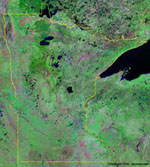
Mapping the Minnesota Food Industry (2009)
A study of Minnesota’s food economy shows relationships are the key to creating the food industry of the future. Read close interviews with food business leaders, and learn a wealth of facts and figures.
Food With the Farmer’s Face On It: Emerging Community-Based Food Systems (2003)
Emerging in thousands of communities all over the U.S., the community-based foods movement seeks to find “Food With the Farmer’s Face On It.” The W. K. Kellogg Foundation asked Ken Meter to produce a media guide introducing readers to this vital movement.
Generic Scope of Work for Local Economic Analysis
Local foods leaders of 95 regions in 32 states and one Canadian province have asked Ken Meter to study their local farm and food economy. His analysis has played a critical role in animating local foods activity across the continent.
Finding Food in Farm Country (2001)
Launching all of this activity was Ken Meter’s original “Finding Food in Farm Country” study of Southeast Minnesota, commissioned by Community Design Center and the Experiment in Rural Cooperation. This has been used as a reference in at least 12 university programs.
Fifty-Year Vision & Indicators for a Sustainable Minneapolis
The City of Minneapolis won national recognition for its sustainability initiative. Central to that effort was a fifty-year vision for the city’s future, and specific measures of sustainability, devised by city residents. The public process for defining these indicators was coordinated by Ken Meter of Crossroads Resource Center. This is a fundamental document to read if you want to measure sustainability.
Neighborhood Commercial Development for the Long Term
Our position paper shows that building strong neighborhood commercial districts involves building wealth for local residents.
 Video:
Deconstructing Dinner
Video:
Deconstructing Dinner